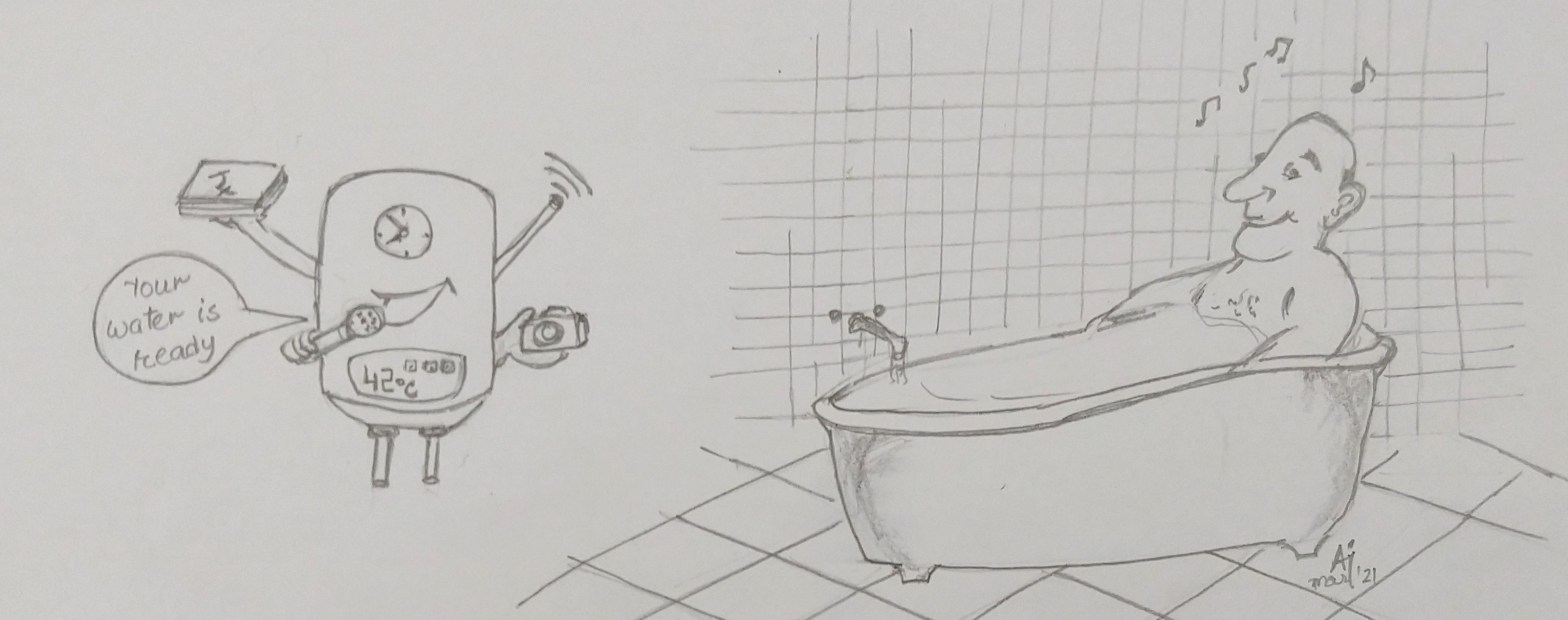
As I advance in age, the winter season gets harder on me. I wish for hot water to take my bath, warm water to wash my hands. I try to get the bathroom before my wife does, otherwise the water is not hot enough for my liking. On the really good days, I get to take my bath before the washing machine has been started. I cringe when I see the electricity bill.
This year I was thinking about what would be needed to make my life easier in the winters. Especially as I become older and crankier, this would make my wife’s life easier too. We hear the terms Internet of Things, Smart Devices, Private Transportation as a Service, etc. These were all rattling around in my brain when I thought about how the Electric Geyser could be a Service Provider. The service in this case would be to predict when we needed the water, at what temperature and how much. Of course we would want this delivered at minimum cost (small electricity bill). Finally at the end of the day, when there is no further demand for hot water, there should be as little hot water remaining in the geyser store as possible.
If the geyser must deliver the requisite amount of hot water at the desired temperature, on demand, it needs to learn the daily routine / usage pattern of the client(s). Three litres at 7 am, 80 litres between 8 and 9 am, five litres throughout the rest of the day, and two litres at 10 pm. There may be more than one client to serve, and each of the clients may have their own consumption patterns. In addition to the volume of water, the clients may have their own choices of temperatures at which they would like the water to be delivered.
The geyser must account for the time it takes to heat the water (we will assume that there will be no power cuts). It also computes the cost to keep the water hot when it is not being used by the client. Higher the temperature, greater the losses.
This description of the Geyser as a Hot Water Service Provider shares a lot of features with an optimization problem I had solved when I was young (but that’s another story for another day). The key aspect is to deliver a service under varying conditions to multiple users or clients while maintaining the quality of service and ensuring the least cost.
In the early 90’s such a system would have been unaffordable for a typical household. Advancements in the fields such as Sensors, Artificial Intelligence, Internet of Things and Cloud computing have brought down the costs down, and today the necessary hardware and software pieces are not so hard to build.
Perhaps if I was twenty years younger I would have jumped at the possibility of bringing such a service to life. Today I wish for someone with technical skills and entrepreneurial passion to pick up the gauntlet. As for me, I will settle for the hot water.


wonderful. Put me on your mailing list. dipankar.moitra@mail.com
LikeLike